

Sand and Gravel Separator Chute Supplier: Key Factors to Evaluate Before Buying
2026-08-22
Choosing the right sand and gravel separator chute supplier can make or break your aggregate processing line. With so many options claiming top performance, how do you separate the reliable from the rest? Whether you're upgrading existing equipment or starting fresh, evaluating key factors like wear resistance, throughput capacity, and after-sales support is critical. That's where Sinou comes in—offering engineered solutions that stand up to real-world demands. In this guide, we'll walk through the essential criteria to consider before making your purchase.
Liner Material Choices That Determine Chute Lifespan
A chute liner's lifespan is rarely decided by a single material property; it's shaped by how the liner responds to the specific way material moves across it. Hardness alone can be misleading—some of the toughest liners in terms of abrasion resistance fail early because they crack under impact or peel away from the chute wall. The real selection process starts with matching the liner's resilience to the dominant wear mechanism at each point in the chute: high-speed impact zones need energy absorption, while sliding zones need low friction and high abrasion resistance. Polyurethane, for instance, often outperforms steel in wet, fine-particle applications because it rebounds instead of gouging, but it can soften and fail in high-temperature dry ore. Ceramic liners excel against sliding abrasion but shatter if hammered by large lumps. Choosing a liner means mapping the chute's flow pattern first, then picking a material that tolerates the worst local condition without sacrificing overall bonding strength.
Bonding and installation method can outweigh the liner material itself. Even the most wear-resistant ceramic or basalt tile becomes useless if the adhesive layer fails, allowing product to get underneath and tear the liner off in sheets. Field experience shows that a softer rubber liner with a reliable mechanical fastening often outlasts a harder ceramic liner that was simply glued onto a flexing chute wall. Temperature swings, chemical exposure from the conveyed material, and vibration all work against the bond line. That's why many operations now prefer modular liner systems that can be replaced in sections rather than one monolithic sheet—downtime drops dramatically when only the high-wear zone needs swapping. The best material choice is the one that stays attached under real operating conditions, not just the one with the lowest wear rate in a laboratory test.
Finally, cost per ton of material conveyed offers a more honest comparison than upfront price per square meter. A premium chromium carbide overlay plate may cost five times more than a standard AR steel liner, but if it lasts eight times longer and reduces unscheduled shutdowns, the total cost of ownership is lower. However, this calculation must include installation labor, expected downtime for changeouts, and the risk of liner failure causing damage to downstream equipment. In many bulk handling plants, switching from a hard, brittle liner to a slightly softer but more forgiving rubber-ceramic composite has cut annual liner replacement costs in half, simply because fewer catastrophic failures occur. The goal isn't maximum hardness—it's maximum predictable service life under the chute's actual duty cycle.
Custom Outlet Geometry for Your Specific Aggregate Mix
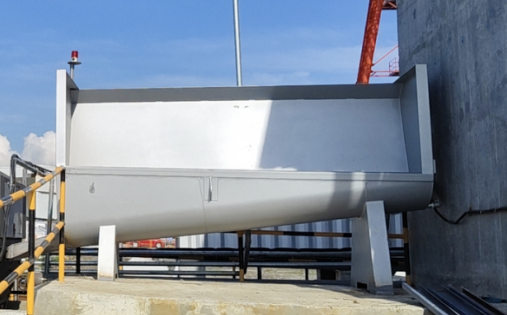
Aggregate mixes rarely behave the way a one-size-fits-all discharge opening expects them to. The angle, taper, and throat dimensions of an outlet have to match how your particular blend of particles actually moves under pressure. If you're working with a high percentage of angular crushed stone, the material will bridge and rat-hole in a standard rectangular port, whereas a rounded river gravel mix might flood through the same opening. We don't start from a catalog of ready-made shapes. Instead, we look at the gradation curve, moisture content, and even the typical resting angle of your specific mix, then adjust the outlet's cross-section and slope so the material releases at a steady, predictable rate.
That level of fit also changes how the equipment handles day-to-day operation. A properly shaped outlet reduces the need for vibrators or air cannons because the aggregate doesn't get the chance to form a stable arch in the first place. For blends that tend to segregate during discharge, the geometry can be tuned to pull from multiple zones at once, keeping fines and larger stones mixed as they leave the bin. Every adjustment is made with your actual material data in hand, not just a general classification like "3/4-inch minus." The result is a discharge path that feels almost invisible in operation, because you stop thinking about blockages and start trusting the flow.
How Suppliers Handle Abrasive Feed Without Premature Wear
Managing abrasive feed is less about finding a miracle material and more about controlling the entire path from hopper to injection point. Suppliers often start by mapping every contact surface, then swap in hardened steel or ceramic-lined chutes only where the material actually tumbles or accelerates. This targeted approach prevents the entire system from becoming a costly wear-part inventory.
Another practical step is adjusting feed speed and drop angles. Slowing the material near corners and using gravity-assisted straight runs reduces the sandblasting effect inside the line. Some shops also install sacrificial wear plates at known impact zones, so routine replacement happens during planned downtime instead of after a surprise blowout.
Finally, consistent feed size matters. By screening out fines and oversize before the abrasive enters the system, suppliers avoid the fine dust that packs into seals and the large chunks that gouge elbows. Combined with regular inspection of high-wear points, this keeps the feed system running longer without constant rebuilds.
What Their Past Installations Say About Real-World Performance
A specification sheet can look flawless in a lab, but installations that have been running for five or ten years tell a different story. Contractors and facility managers who track output, maintenance calls, and part replacements over time get a clear picture of how a system actually behaves under daily load. Past projects expose whether efficiency holds steady or drops after the first season, whether seals and connections survive temperature swings, and whether the promised service intervals match reality.
Looking at a company's completed installations also reveals patterns that marketing materials rarely mention. One project might suffer from a defective batch, but if the same issue shows up across multiple sites, that points to a design or manufacturing weakness. Conversely, when older installations still perform close to their original ratings with only routine upkeep, that consistency is hard to fake. It's the difference between a product that works on day one and one that still works in year seven.
Real-world performance also depends heavily on how the equipment was installed and how responsive the provider was after handover. A track record of successful installations includes not just the hardware, but the support behind it: how quickly problems were diagnosed, whether spare parts were available locally, and how well the system adapted to site-specific conditions. These details only emerge from past deployments, not from controlled tests.
Spare Parts and Emergency Support After the Purchase
When a machine goes down, every hour of downtime eats into your output. That’s why we stock high-failure-rate components like seals, bearings, and drive belts in regional hubs, not just at the factory. If you need a part at 2 a.m., our on-call engineers can confirm compatibility from your equipment serial number and ship it via the fastest available route — sometimes even before you’ve finished your shift report.
Emergency support doesn’t end with a tracking number. Our technical team stays on the line to guide your crew through installation, using video calls when a manual would slow things down. For repeat customers, we keep a digital service log of every replacement, so future orders skip the back-and-forth and go straight to dispatch.
Field Testing Options Before You Commit to a Full Order
Ask the supplier for a small trial batch or sample kit before signing any large purchase order. Run those pieces through your actual production line or daily routine, not just a quick visual check. Look for how the material reacts to your specific environment—humidity, temperature, repeated handling, or cleaning chemicals. A sample that survives a week in your hands tells you more than any spec sheet.
For equipment or tools that are expensive to ship back and forth, see if the vendor offers a short-term loaner or demo unit. Use it on a real job for a few days and pay attention to things like vibration, noise, setup time, and how easily your team adapts to it. Jot down the small annoyances you only notice after hour three. Those are the details that decide whether a full order makes sense.
If you are dealing with a custom product or a new supplier, run a pilot order of perhaps ten to twenty units. Treat it as a live rehearsal: track defect rates, delivery timing, packaging condition, and how responsive the vendor is when you ask questions. Then sit down with your notes and decide if scaling up is worth it. A modest test order costs far less than discovering a mismatch after you have already committed to a container load.
FAQ
Check that the chute body uses abrasion-resistant plate, not standard structural steel. High-chrome or ceramic liners in the impact area will outlast mild steel many times over. A supplier who can show field wear data from sand and gravel sites is far more useful than one who just quotes a hardness number.
Give the supplier exact drawings or photos of your existing hopper, screen, or conveyor connection points. A good shop will ask about drop height, material size, and feed rate before quoting. If they only offer off-the-shelf sizes without asking a single question, walk away.
A supplier who has built chutes for quarries or wash plants knows where the wear points are and how to brace around flanges. Ask for a couple of recent sand and gravel projects and call those buyers. Five years of general sheet metal work is not the same as five years of aggregate handling.
Look for a chute with a straight drop section, minimal ledges, and enough slope to keep wet sand moving. Bolt-on wear liners that can be replaced from the outside save a lot of downtime. If the chute has internal angles where material can build up, you will be beating it with a hammer every shift.
Ask whether the supplier keeps standard chute sections in stock or builds everything to order. A six-week lead time can stall your whole plant if a liner fails. A supplier who can ship a replacement chute or wear parts within days is worth a slight price premium.
You want a supplier who answers calls after the sale, keeps wear parts on hand, and can send someone out if alignment problems show up during installation. Ask about their warranty on liners and what they do when a chute cracks at a weld. If they dodge the question, that is your answer.
Yes, because the chute frame can last for years while the liners are the real consumable. Bolt-on or clamp-on liners let you swap out the worn sections in a couple of hours instead of cutting and welding a whole new chute. The upfront cost is a bit higher, but the downtime savings usually pay for it within a year.
Most serious suppliers can point you to a nearby plant where their chutes are running. Ask for a site visit or at least a short video of a similar installation. If they refuse or only offer glossy brochures, that is a red flag. A company that stands behind its work will not hide from a field check.
Conclusion
Before signing with a sand and gravel separator chute supplier, you need to dig into liner materials rather than just accept a generic specification. The choice between polyurethane, ceramic tiles, or AR steel liners changes how long the chute survives abrasive sand and rock. A supplier that asks about your specific aggregate mix and offers custom outlet geometry is far more valuable than one selling a one-size-fits-all design. Ask how they manage highly abrasive feed; some use replaceable wear bars or clever flow redirection to extend service intervals. Their past installations tell you more than a polished brochure. Request site references where similar aggregate types were handled and ask about measured wear rates or downtime events.
After the purchase, spare parts availability and emergency support become critical. A chute that fails during peak season can idle an entire plant, so check lead times for wear components and whether the supplier stocks critical items locally. Also look for field testing options before committing to a full order. A supplier willing to run a pilot with your actual material, even for a few weeks, gives you real-world data on wear and flow behavior. These steps remove guesswork and help you choose a supplier that will keep your operation running instead of becoming another maintenance headache.
Contact Us
Contact Person: HaiYan
Email: [email protected]
Tel/WhatsApp: +86 18957325588
Website: https://www.senyoubeton.com/