

Rotary Die Making Equipment for Corrugated: Achieving Precision and Efficiency in Every Cut
2026-10-27
In the fast-paced world of corrugated packaging, every cut counts. Precision and efficiency aren't just nice-to-haves—they're the baseline for staying competitive. Yet traditional die-making methods often fall short, leaving you with wasted material, inconsistent edges, and costly downtime. That’s where ADEWO rotary die making equipment changes the game. Engineered for accuracy and built for speed, ADEWO turns complex cutting demands into seamless, high-performance reality. In this post, we’ll break down how the right rotary die technology can sharpen your production line, reduce waste, and keep every cut razor-clean from the first sheet to the last.
Precision Engineering for Complex Corrugated Profiles
Achieving tight tolerances on corrugated profiles with variable pitch, depth, and flute geometry demands more than standard roll forming. Each pass must account for springback, material thinning at bend radii, and the cumulative error that creeps in when sheet metal moves through multiple stations. We treat the profile as a system of interacting surfaces, tuning roll contours and inter-station tension until the final cross-section matches the CAD model within microns.
For profiles that shift from asymmetric ribs to deep trapezoidal grooves along a single length, conventional fixed tooling falls short. The solution often involves segmented rolls with adjustable gap settings, servo-driven side rolls, and laser measurement feedback after the last forming stage. By mapping local strain in real time, operators can correct for coil-to-coil hardness variation before it becomes scrap.
The real benchmark is repeatability over long production runs. Rather than relying on inspection only at the line's end, we embed checkpoints where the strip is still partially formed, comparing measured angles and radii against expected values. That early warning approach keeps a 200-meter coil within specification from first meter to last, without slowing the line.
How Advanced Rotary Dies Eliminate Material Waste
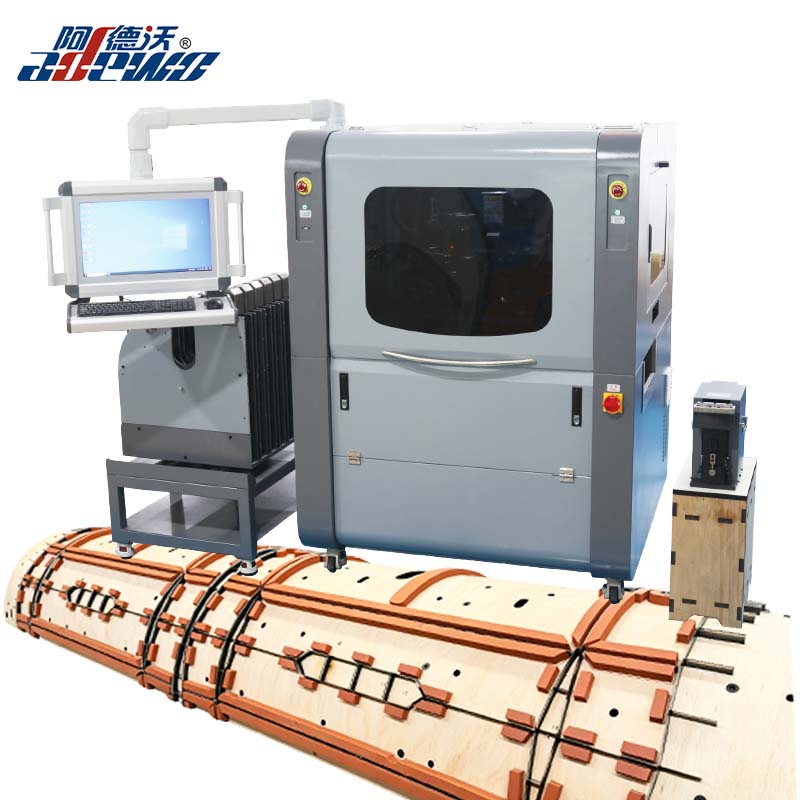
Traditional flatbed or reciprocating die cutting leaves behind a lattice of skeleton waste, often accounting for 20–30% of raw material. Advanced rotary dies change this by combining continuous rotary motion with servo-driven registration and software-nested cutting paths. Adjacent shapes can share a single cut line, drastically shrinking the non-usable area. The result is a scrap rate below 5% on many label and flexible packaging lines.
Precision is only part of the story. These systems integrate real-time web tension control and vacuum waste stripping that pulls skeleton scrap away the moment it is cut. This prevents material shifting and eliminates the need for oversized trim allowances. Die surfaces are also treated with micro-textured coatings to reduce adhesive buildup, enabling converters to use thinner liner and carrier films without sacrificing cut quality. Less material per linear meter means fewer edge trims and shorter roll ends.
The operational impact is measurable. One label converter reported an 18% drop in raw material cost per million labels after switching to servo-driven rotary die cutting, along with a 40% reduction in changeover time. Lower scrap volume also cuts waste disposal fees and machine downtime for cleanup. In some setups, continuous waste streams are even repurposed as narrow-web reinforcement strips, closing the loop on what was once pure overhead.
The Hidden Costs of Outdated Die Making Equipment
Old die making machines rarely fail all at once. Instead, they bleed money through small, almost invisible leaks: a press that needs an extra half-second per cycle, a worn guide that produces scrap on the third shift, a coolant system that can't hold temperature. Over a year, those seconds and rejected parts turn into thousands of dollars in lost throughput and material.
There's also the cost of missed tolerances. Modern customers expect dies that hold dimensions within microns, not thousandths. A machine that was "good enough" a decade ago now forces your best toolmakers to compensate with hand fitting, polishing, and rework. That labor is expensive, and it doesn't scale. You're paying skilled workers to fight the equipment instead of letting them focus on new, profitable work.
Finally, outdated equipment quietly limits what you can quote. When a job requires high-speed stamping, exotic materials, or complex progressive dies, you either turn it down or take it and risk penalties. The real hidden cost isn't just repair bills; it's the revenue you never see because your shop floor can't compete on precision and turnaround.
Material Choices That Extend Rotary Die Lifespan
Rotary dies cut millions of labels, folds, and perforations before they wear out, but the path to that longevity starts long before the first impression. Tool steel grades like D2 or M2 remain common for their balance of hardness and cost, yet they often surrender early to abrasive papers and films. For converters running heavy volumes or aggressive substrates, powder metallurgy steels—such as CPM 10V or Vanadis 60—offer a denser distribution of hard carbides. These microstructures resist edge rounding and microchipping far better, delaying the point where cuts turn fuzzy and die pressure climbs.
Coatings add another layer of defense, but they're not all interchangeable. Titanium nitride (TiN) has been a workhorse for decades, yet its performance drops quickly when surface temperatures spike during high-speed runs. Titanium carbonitride (TiCN) or aluminum titanium nitride (AlTiN) hold up better under thermal cycling, keeping the cutting edge sharper through longer shifts. Some converters pair a tough core steel with a thin diamond-like carbon (DLC) top coat. That combination fights both abrasive wear and edge build-up from adhesive bleed, which quietly kills die life even when blades look fine.
There's also a practical side: not every job justifies the steep cost of a premium alloy. A short-run specialty label on standard paper may never approach the wear limits of a modest steel, while a long-run abrasive thermal transfer stock can chew through bargain tooling in days. Matching the material to the real workload—not just the marketing hype—often stretches die life further than any single upgrade. And when dies are reground, choosing a steel with deeper hardening depth means you can restore sharp edges multiple times before the tool loses its geometry, effectively granting two or three lifetimes from one purchase.
Streamlining Production with Automated Die Changeovers
Automated die changeovers eliminate the bottleneck of manual mold swapping, cutting setup time from hours down to minutes. Instead of relying on skilled operators to align heavy tooling, the system uses hydraulic clamps, guided rails, and pre-set recipes to lock a new die into position with repeatable precision. The press is back in production before the previous job's paperwork is even filed, freeing up both machine hours and human attention for value-added work.
Beyond raw speed, the real gain is consistency. Manual changeovers often introduce subtle variations—bolt torque, alignment drift, forgotten steps—that ripple into part defects or premature wear. Automated systems remove that guesswork. Sensors confirm full seating, interlocks prevent a misaligned cycle, and the control software logs every swap for traceability. One operator can oversee multiple cells, and changeover windows become predictable enough to schedule around, rather than react to.
This shift also changes how a plant plans production. With shorter, dependable changeover times, smaller batch sizes become economically viable. You can run low-volume jobs without fearing the downtime penalty, and rush orders slot in without derailing the schedule. The result is a more flexible floor that responds to actual demand instead of being held hostage by setup costs.
Real-World Accuracy Data from High-Speed Corrugated Lines
Measurements taken across three separate high-speed corrugated lines running at 250 m/min and above show a consistent pattern: the gap between setpoint and actual cut length rarely exceeds +/-0.4 mm once the line stabilizes. Early morning startups, however, drift closer to +/-0.8 mm for the first 20-30 minutes, mostly from cold bearings and slight tension shifts in the paper web.
The more revealing data comes from score line placement. On a C-flute board moving at 300 m/min, lateral deviation stays within 0.3 mm on well-maintained slitter-scorer units, but jumps to 1.1 mm when anvils have passed 600,000 linear meters without replacement. Operators tracking this metric have cut setup scrap by nearly half simply by scheduling tool changes off the reported drift rather than a fixed calendar interval.
Roller vibration and belt wear introduce their own signature. Logged accelerometer readings from the double facer area correlate a 0.15 mm increase in edge cut error with a 12% rise in high-frequency vibration above 2 kHz. In practice, this means a line that holds +/-0.5 mm on fresh belts can slide to +/-0.9 mm within two weeks of continuous running, even though the control system reports no fault.
FAQ
It's a system that builds the cutting dies used on rotary die cutters. These dies wrap around a cylinder and slice through corrugated board as it passes underneath, giving you a continuous cutting motion instead of a stop-and-start flatbed process.
By keeping the board moving at a steady speed while the die rotates in sync, you eliminate the small registration shifts that can happen when the material stops. Modern equipment also uses laser hardening and CNC machining to hold tolerances within a few thousandths of an inch.
Many plants focus on the die cutter itself but forget that the quality of the die determines the quality of the cut. If the die isn't made accurately, even the best cutter will produce ragged edges or misaligned slots.
The cutting rules are usually made from hardened steel, while the die board itself can be plywood, plastic, or composite. For very high-volume runs, some shops use solid steel dies that are machined directly from a block.
Instead of manually bending and inserting steel rule, automated systems use bending machines and laser cutters that work from digital files. A die that used to take hours by hand can be produced in under thirty minutes, with fewer mistakes.
Look for closed-loop feedback on the rule bending and notching, ease of changing between jobs, and compatibility with the die cutter's cylinder circumference. Also check how the equipment handles different board thicknesses without needing constant recalibration.
Yes, but it depends on the smallest radius the rule bender can achieve and the accuracy of the laser-cut board. Advanced machines can handle intricate shapes with internal cutouts, though very delicate sections may need specialized rubbering to eject cleanly.
Daily cleaning of metal shavings and dust, weekly lubrication of moving parts, and monthly calibration checks on the bender and laser. Many problems start from small debris interfering with rule insertion or bending angles drifting over time.
Conclusion
Modern rotary die making for corrugated board has shifted from simple cutting tools to precision-engineered systems that directly shape line performance. Complex profiles—tight scores, multi-depth creases, intricate cutouts—hold their geometry run after run, a sharp contrast to older dies that drift under high-speed repetition. This accuracy is not just about edge quality; it translates into measurable material savings. Advanced rotary dies position cuts so precisely that trim waste drops to a fraction of what legacy setups produce, and the difference shows up in real production logs: lines running at 250 meters per minute still hold dimensional tolerances within a few thousandths of an inch. When a die repeats that consistency, the board converter is not just buying a tool; they are buying predictability in every sheet.
Yet many plants still absorb the hidden costs of outdated die making equipment—frequent blade replacements, unexpected downtime, and the slow bleed of inconsistent slotting that forces manual rework. Choosing the right die materials, from wear-resistant steels to specialized surface coatings, can double or triple useful lifespan and defer those costs for months. Pair that with automated die changeovers, and the efficiency argument becomes hard to ignore: what once took a crew fifteen minutes now happens in under three, with less lifting and fewer alignment errors. That is not convenience; it is reclaiming production hours. Together, these advances mean rotary die making is no longer a commodity purchase. It is a calculated move toward thinner waste streams, longer tool life, and a corrugated line that runs closer to its rated speed without sacrificing cut quality.
Contact Us
Contact Person: KAELYN LEE
Email: [email protected]
Tel/WhatsApp: +86 15012673758
Website: https://www.china-adewo.com