

Reliable Light Guide Plate Characteristics That Improve Display Quality
2026-11-17
Most display specs focus on resolution and brightness, but the quiet reason a screen looks evenly lit from edge to edge is the light guide plate inside it. A reliable LGP does more than carry light—it controls how much reaches every corner without hotspots or dim patches. From precise dot microstructures and optical-grade material choice to tight thickness and thermal behavior, these characteristics shape contrast, color consistency, and long-term brightness retention. At Meld Display, we treat the light guide plate as a performance layer, not a commodity part. This post breaks down the LGP traits that actually move the needle on display quality, and where most designs still go wrong.
Where LED Hot Spots Go to Disappear
A row of diodes behind a basic lens doesn't read as one light source. It reads as a sequence of tiny bright dots, especially on polished counters or glossy floors. This is where those dots get erased. The optics overlap each diode's output with the output beside it before the beam reaches the room. What starts as individual points turns into a continuous spread, with no obvious center and no hard edges.
The effect is visual rather than technical. Switch the fixture on and the light seems to come from nowhere in particular, settling softly across the surface below. You notice the room first, not the fixture. That shift is what separates lighting that feels assembled from lighting that feels deliberate.
Thermal Expansion Is Quietly Shifting Your Brightness
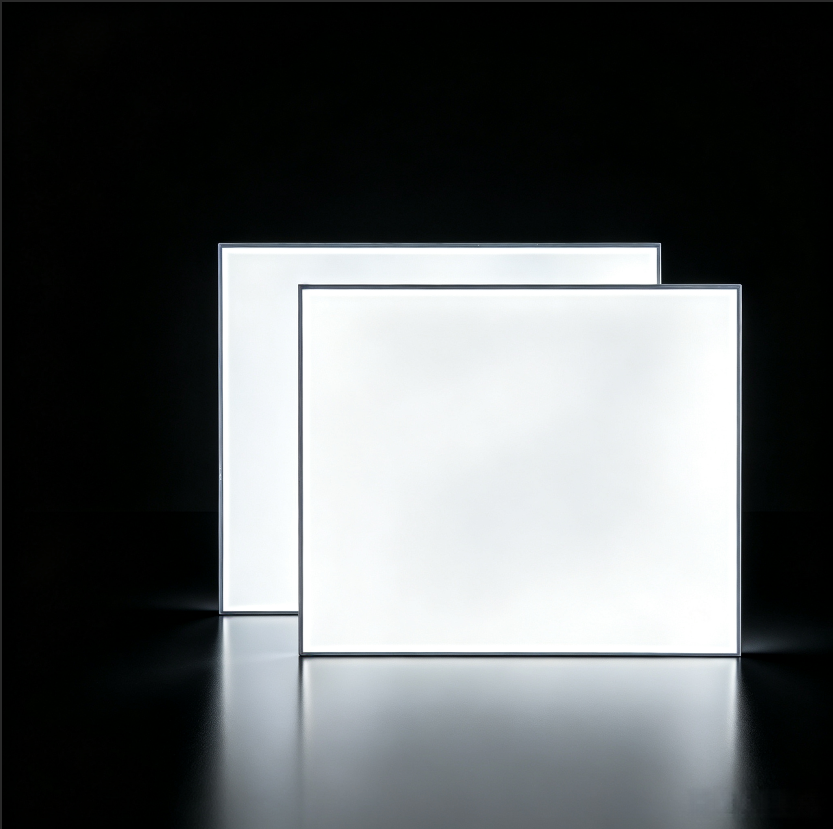
Most people assume their display's brightness stays constant once set, but the physical structure behind that light tells a different story. The layers inside a screen—especially the backlight assembly and the frame holding it—expand and contract with temperature changes. When the room warms up, metal rails and plastic guides shift by fractions of a millimeter, and that subtle movement alters how light is distributed across the panel. You might not notice it from one minute to the next, yet over an hour of use, the screen can drift several percent brighter or dimmer without a single touch of the controls.
Heat doesn't just push components around; it also changes how efficiently the LEDs or OLED emitters convert current into visible light. As the internal temperature climbs, electrical resistance in the driver circuitry rises, forcing the power supply to compensate. Some panels overcompensate slightly, causing the image to look washed out on a hot day or right after a demanding game. On the flip side, a cold start in a chilly room often produces a dimmer, muddier picture until the thermal profile stabilizes.
What makes this effect easy to miss is its slow, quiet nature. Unlike a flicker or a stuck pixel, thermal expansion nudges brightness in a gradual curve. Calibration tools that run for only a few minutes rarely capture the full range of drift, because the display hasn't reached thermal equilibrium yet. If you've ever felt your screen looked different after lunch than it did in the morning—without adjusting anything—the thermal behavior of its internal frame may have been quietly doing the shifting for you.
Why Material Purity Decides Long-Term White Points
Impurities rarely announce themselves at the placement visit. They sit quietly in the resin matrix or ceramic block, then respond to moisture, pH shifts, and repeated temperature cycling. In low-purity materials, metal oxides and leftover processing agents slowly migrate toward the surface, creating faint white opacities that no amount of polishing can remove. Those spots are not stains in the usual sense; they are optical disruptions caused by particles that scatter light differently than the surrounding material.
A highly refined filler network stabilizes long-term optics because there is less reactive debris available to trigger localized crystallization or water uptake. When the raw filler is washed and silanized under tight controls, the cured material keeps its translucency instead of drifting into cloudy white patches at the margins and body. That difference becomes obvious around year three or four, once cheaper alternatives begin showing white speckling that cannot be reversed with surface glaze or repolishing.
For clinicians, this means purity is not just a specification on a data sheet. It shapes how the restoration ages in a wet, enzyme-rich environment. Small particles of iron, tin, or unreacted peroxide can nucleate microscopic voids that fill with water, and water has a refractive index far enough from the polymer or glass to register as white. Choosing raw ingredients with tighter tolerances keeps the internal phase boundary clean, so the restoration stays visually quiet over time.
Surface Finish Can Make or Break Light Extraction
A surface that looks smooth to the naked eye can still be littered with micron-scale pits, ridges, and polishing streaks. Those tiny imperfections decide whether a photon leaves the chip or bounces back inside. Even a few nanometers of unintended roughness can scatter light at angles that no longer meet the escape cone, quietly erasing a double-digit percentage of potential output. Optical designers often discover this only after the die is already in production, when the measured luminance refuses to match the simulation.
It's tempting to assume that a mirror finish is always the answer, but light extraction rarely works that way. A perfectly specular surface can trap rays in a loop of total internal reflection until they get absorbed by the substrate or the rear mirror. Controlled roughness, on the other hand, breaks that loop. A lightly textured interface gives photons another roll of the dice each time they strike it, and some of those redirected angles finally slip through. The goal isn't smoothness for its own sake—it's a surface whose unevenness is tuned to the chip's refractive index and emission profile.
Manufacturing leaves fingerprints everywhere on the emitting face. Injection-mold flow lines, tool marks from diamond turning, etch residue, even the faint haze left by a cleaning solvent all reshape how light exits. These aren't cosmetic details; they are optical elements formed by accident. A LED or microdisplay that loses 12% to a rough mold cavity will never recover that light downstream. So before chasing brighter phosphors or higher drive current, it's worth looking at the surface under an interferometer. Sometimes the cheapest lumen gain is hiding in the texture nobody measured.
Slim Panels Need More Than Just Optical Polish
A mirror-like surface on a slim panel can hide very little once the panel leaves the flat inspection table. Thickness variation, micro-bowing, and edge stress all become visible under raking light, and optical polish alone cannot compensate for these underlying irregularities. The eye picks up every slight undulation, especially across large uninterrupted surfaces.
What actually keeps a thin panel looking refined is the work done before and after polishing: controlled stock removal, stress relief, and careful edge detailing. A high-gloss finish without dimensional stability will read as wavy or brittle in real installation conditions. The polish is simply the final layer of a much longer process.
Thin formats also change how light travels across the surface. A brilliant polish will still reveal density shifts or subsurface texture unless the panel carries a consistent micro-profile. In practice, flatness and edge condition are checked alongside gloss, because reflection quality on a slim panel is never just about the outermost layer.
Yellowing Drift Is Not Inevitable in Edge-Lit Displays
Edge-lit backlights get blamed for a slow shift toward yellow, but the cast usually comes from concentrated heat near the diode strip rather than the architecture itself. When LEDs run hot, the phosphor and nearby light-guide materials age faster, and that is what drags the white point toward warmer tones.
The fix starts well before the panel is assembled. Tighter chromaticity binning, lower drive currents, and cooler-running LED packages reduce strain on the materials that discolor first. Adding a more efficient thermal path between the LED rail and the frame also flattens hot spots, so the center and edges age at a closer rate.
Optical films and diffuser stacks matter just as much. A well-designed coupler spreads the light before it enters the guide plate, which keeps the initial blue-and-phosphor mix from striking the same area with high intensity. With that approach, yellowing drift becomes a design trade-off, not a guaranteed symptom of edge-lit backlighting.
FAQ
It usually comes down to consistent thickness, clean light coupling at the input edge, and microstructures that spread light without creating visible hotspots. A dependable plate also holds its shape after thermal cycling instead of warping.
They disrupt the light path so photons don't simply travel straight from the LEDs to the far edge. This produces more even luminance across the screen and reduces bright spots near the light source.
High optical clarity and a low yellowness index are critical because they keep the light bright without shifting the white point. Impact resistance and low moisture absorption also help the plate maintain its optical behavior over time.
Yes. If the plate expands unevenly it can warp, press against the LCD, or change the air gap. That leads to visible mura, uneven brightness, or even stress marks. A reliable plate is designed with enough thermal headroom for the product's operating range.
Cheap plates often show non-uniform dots, poor edge finishing, or material impurities that scatter light unpredictably. Over time they may yellow or deform. A reliable plate keeps its brightness distribution stable through repeated heating and cooling.
They typically inspect thickness tolerance, surface roughness, dot pattern fidelity, and edge flatness. A quick visual test with a uniform backlight can reveal bright bands, dark corners, or rings that would cause field failures.
Light enters through the edges, so scratches, chips, or uneven polishing at that surface scatter energy before it can be guided. Even small defects there can lower overall light output and create visible streaks.
Conclusion
Light guide plates rarely get much attention until a display shows uneven brightness or a patch of yellow near the edge. In practice, dependable optical performance starts with the plate itself. A well-designed pattern and closely controlled material blend allow LED hot spots to fade before they reach the viewing area, so the screen reads as one smooth plane instead of a row of bright dots. At the same time, thermal expansion cannot be ignored. Plates that hold their geometry under moderate heat keep the light distribution stable, which matters far more than a perfect initial measurement on a bench. Purity also plays a quiet role: contaminants that begin invisible can slowly shift the white point, giving older panels a tired, off-color look that users notice even if they cannot name it.
Surface finish decides how much light actually leaves the plate, not just how much enters it. A finish tuned for extraction can lift brightness without adding power, while an overly polished face may trap light or create subtle banding. Slim panels make this balance harder because there is less thickness to hide flaws, so the plate has to be more than optically clear. It has to be mechanically consistent and matched to the diffuser and prism stack. Edge-lit displays also do not have to drift toward yellow. With stabilized materials and a controlled production process, the neutral white point can survive years of daily use. Taken together, these characteristics separate a light guide plate that merely works on day one from one that keeps the display looking clean, even, and color-stable over time.
Contact Us
Contact Person: Sky Wang
Email: [email protected]
Tel/WhatsApp: 8613430620125
Website: https://www.meldled.com/