

Reliable Food Grade Oil-Free Air Compressor: Essential Features for Contamination-Free Air
2026-08-15
In food and beverage production, the air that touches your products can make or break both safety and quality. Yet many facilities overlook the hidden risks lurking in compressed air systems—from oil carryover to microorganism growth—that can silently compromise batches and trigger costly recalls. Choosing a reliable food grade oil-free air compressor isn't just a technical detail; it's a critical line of defense. At Seize Air, we understand what contamination-free air truly demands. In this post, we'll break down the essential features that set dependable systems apart and help you protect your process from invisible threats.
A Single Drop of Oil Can Shut Down a Line
On a modern assembly floor, the margin between smooth throughput and an unplanned stoppage can be thinner than a fingerprint. A droplet of oil that settles on a camera lens or a laser sensor can blur a critical read, causing the system to reject good parts or, worse, fail to spot a defect until it has already moved downstream.
Hydraulic and pneumatic circuits are equally unforgiving. One stray drop drawn into a servo valve can disrupt the precise flow that positioning actuators rely on, leaving a robot arm twitching out of tolerance. The result is rarely a dramatic failure—instead, the line slows, alarms flash, and a maintenance crew spends hours tracing a fault that began with an almost invisible contaminant.
Even outside the machinery, oil on a work surface changes the friction a gripper expects. A part that should sit squarely in a fixture can slide a few millimetres, enough to jam a downstream station. Keeping surfaces dry and clean is not just housekeeping; it is a direct defence against the kind of shutdown that no amount of rescheduling can fully recover.
Why Food-Grade Air Starts with the Compressor Core
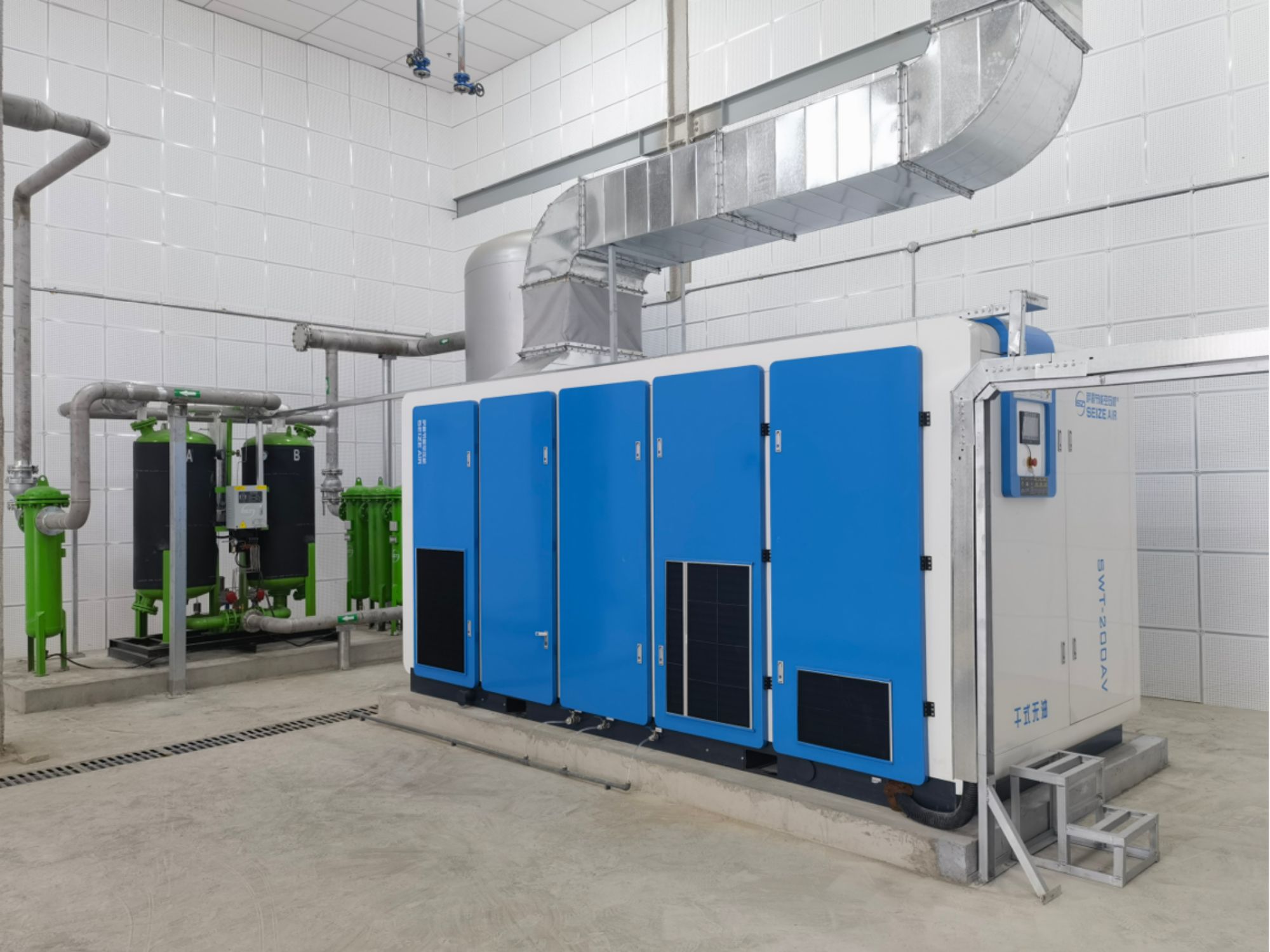
Plenty of plants treat compressed air quality as a downstream problem—add a filter bank, swap in a desiccant dryer, and call it food-grade. That approach misses where contamination actually starts. Inside the compressor core, the airend, shaft seals, and surface coatings are the first surfaces that touch the air. If those aren't designed to prevent oil carryover, metal fines, or moisture-driven corrosion, everything bolted on afterward is just compensating for a dirty source.
Oil-free core designs help by removing the lubricant reservoir from the compression chamber, but they aren't automatically food-safe. The trade-off is higher heat and tighter tolerances, which means rotor coatings and bearing materials have to withstand constant thermal cycling without shedding particles or off-gassing. A core built with generic industrial alloys may pass a performance test yet still release trace elements that a food safety audit would flag.
That's why the core, not the filter spec sheet, is the real starting point. Food-grade air depends on stainless steel internals, sealed bearings, and coatings rated for incidental contact. Once the compression stage itself is clean by design, the downstream filtration can do its job without being the only line of defense.
The Filtration Myth: What Actually Keeps Air Pure
Most people assume that a high-efficiency filter is the heart of clean indoor air, but that belief often misses a quieter truth. Filters trap particles, yes, but they do not address the invisible gases, humidity imbalances, or the slow drift of pollutants that settle on surfaces. Real purity comes from a system that manages air exchange, moisture, and source control together, not from a single woven mesh.
Think of a room where the filter is spotless, yet the air still feels heavy. The culprit is usually stagnation. Fresh outdoor air, when introduced at the right rate, dilutes what filters cannot catch. Meanwhile, keeping humidity between forty and sixty percent stops mold spores and dust mites from thriving. A filter is only one player; ventilation and moisture control quietly do the heavy lifting that no fiber can replicate.
So before upgrading to the densest filter on the market, ask what you are actually fighting. Cooking fumes, off-gassing furniture, and tracked-in pollen each demand a different strategy. Pair a modest filter with a steady trickle of outside air, wipe down surfaces with plain water, and let the room breathe. Air stays pure not because a single barrier is heroic, but because the whole environment is balanced.
Design Choices That Eliminate Lubrication Entirely
Traditional mechanical assemblies depend on periodic lubrication to manage friction and wear, but this reliance introduces maintenance schedules, contamination risks, and performance limits in extreme environments. Design choices that eliminate lubrication entirely start with material selection. Self-lubricating composites, such as those combining a polymer matrix with solid lubricants like PTFE or graphite, inherently reduce friction without liquid films. Ceramics and certain engineered plastics also exhibit low friction coefficients when paired correctly, enabling dry running.
Beyond materials, the geometry of interacting surfaces plays a decisive role. By shaping contact interfaces to promote hydrodynamic or hydrostatic air films—even at low speeds—designers can create bearings that ride on a cushion of gas instead of oil. Surface textures, such as micro-dimples or deterministic patterns, trap debris and manage particle flow, further reducing the need for external lubricants. Pairing hard, polished coatings like diamond-like carbon (DLC) with these textures minimizes adhesion and galling, even under high loads.
These approaches converge in applications like vacuum systems, food processing equipment, and high-temperature machinery where liquid lubricants would fail or contaminate. Eliminating lubrication not only cuts operating costs but also extends service intervals and allows components to function in cleanrooms or space environments. The key is integrating material, geometry, and surface treatment from the outset rather than retrofitting a dry solution later.
Dry Air, Zero Particles: The Unseen Requirements
In advanced manufacturing and laboratory environments, the air itself becomes a critical raw material. Two properties often overlooked by outsiders are its moisture content and the number of suspended particles. Dry air, typically with a dew point far below freezing, prevents unwanted chemical reactions and condensation on sensitive surfaces. Zero particles—meaning virtually no airborne contaminants—ensures that even the smallest speck of dust doesn't ruin a wafer, contaminate a culture, or clog a precision nozzle. Together, these conditions form an invisible infrastructure that allows modern technologies to function at all.
Achieving both dryness and particle-free status demands a layered approach. Desiccant dryers pull water vapor out of the supply, while high-efficiency particulate air (HEPA) and ultra-low penetration air (ULPA) filters trap particles down to fractions of a micron. But the real challenge lies in maintaining these conditions over time: a single leaky seal, a poorly fitted glove, or a momentary pressure drop can reintroduce moisture and dust into a supposedly controlled space. Facilities monitor these parameters continuously, because the failure often isn't dramatic—it shows up later as a batch of rejected products or a mysterious equipment malfunction.
The phrase "unseen requirements" is fitting because neither dry air nor particle-free conditions can be perceived by human senses. An operator can stand in a cleanroom and feel comfortable, yet the air might carry ten times the allowable particles or a dew point above specification. That invisibility makes training and documentation just as important as the hardware. People must learn to trust instruments over intuition, and to follow protocols that seem excessive until something goes wrong. In the end, these unseen properties separate a facility that merely looks clean from one that truly is.
Reliability Without Oil Changes: What to Look For
When a vehicle is advertised as reliable without regular oil changes, it's usually not magic—it's design. Look for engines with exceptionally tight tolerances, low-friction internals, and oil filtration systems that trap contaminants before they circulate. Some hybrids and electric vehicles sidestep the issue entirely by running the engine less often or not at all, which naturally extends oil life. But even in conventional cars, a robust PCV system and a large oil sump can stretch intervals well beyond the old 3,000-mile rule.
The real tell is in the owner's manual, not the marketing. If the manufacturer specifies a 10,000-mile or 12-month oil change interval as normal, that's a sign of confidence in the engine's ability to resist sludge and viscosity breakdown. Pay attention to whether the car uses synthetic oil from the factory—many modern engines do, and synthetic base stocks resist thermal degradation far better than conventional oil. Also check for an oil-life monitoring system that adjusts intervals based on actual driving conditions rather than a fixed mileage.
Finally, consider the vehicle's history and cooling system. An engine that runs consistently cool and has never been overheated is far less likely to suffer from oil coking or accelerated wear. Look for evidence of regular maintenance in other areas, because a neglected cooling system can undo all the benefits of long-life oil. In short, reliability without frequent oil changes isn't a single feature—it's a combination of engine design, oil type, and thermal management working together.
FAQ
It must be designed to eliminate any risk of oil carryover or particle contamination into the air stream. That means using oil-free compression elements, food-safe materials for wetted parts, and filtration rated for direct or indirect food contact. Certifications like ISO 8573-1 Class 0 or FDA-compliant components are typical markers.
In lubricated compressors, tiny oil droplets can migrate past seals and into the compressed air. Even trace amounts can alter flavor, cause spoilage, or fail audits. An oil-free design removes that failure point entirely, which is why many facilities treat it as non-negotiable for critical contact points.
Look for a true oil-free air end with coated rotors or scroll elements, high-efficiency coalescing and particulate filters, stainless steel or anodized aluminum components where moisture may collect, a refrigerated or desiccant dryer, and simple access for cleaning and inspection. Vibration isolation and a low-noise enclosure are also important in production areas.
It uses multiple barriers: oil-free compression removes the main source of hydrocarbon contamination, multi-stage filtration captures particles down to 0.01 micron, a dryer lowers the dew point to prevent microbial growth, and often a point-of-use sterile filter is added right before the air contacts food or packaging.
Regularly inspect and replace intake filters, check condensate drains, verify dryer performance, and monitor differential pressure across filters. Even without oil, wear on bearings and seals can introduce particulates, so scheduled inspections of the air end and tightening of fittings are key. Keep a log to catch subtle changes early.
Modern oil-free machines are built with advanced coatings and materials that handle high temperatures and continuous duty well. While historically they had shorter service intervals, current designs often run 8,000 to 16,000 hours between major overhauls. The trade-off in maintenance is usually offset by eliminating oil changes and reducing contamination risk.
Drying is essential because moisture in compressed air can support bacteria, mold, and yeast growth inside piping. A pressure dew point of -40°F or lower is common for food plants. Refrigerated dryers work for non-critical uses, but desiccant dryers are preferred when air touches product or packaging.
Periodic air quality testing is the only sure way. Use a lab to measure oil mist, particles, water content, and microbial load at various use points. Some facilities install continuous particle counters or dew point monitors for real-time confidence. Testing should follow ISO 8573 or SQF guidelines.
Conclusion
In food processing, even a single drop of oil can force a line shutdown, contaminating product and triggering costly recalls. That's why reliable food-grade air starts deep inside the compressor core, not with downstream filters. Many plants still rely on filtration to catch oil carryover, but filters clog, saturate, and fail silently. True purity comes from design choices that eliminate lubrication entirely—sealed bearings, dry-running cylinders, and specialized coatings that never need oil changes. Without oil in the system, there's nothing to leak into the air stream.
Yet oil-free alone isn't enough. Dry, particle-free air demands integrated moisture separators, desiccant dryers, and sub-micron filtration for particulates. The compressor must maintain dew point stability across varying loads and ambient temperatures. Reliability without oil changes hinges on durable components: stainless steel valves, long-life seals, and heat exchangers that shed heat efficiently. Look for units with low vibration, easy-access service points, and proven runtime in sanitary environments. The result is compressed air that meets FDA and HACCP standards without constant monitoring or replacement filter costs—a system that simply won't contaminate your product.
Contact Us
Contact Person: Mia
Email: [email protected]
Tel/WhatsApp: +86 19821985894
Website: https://www.seize-air.com