

PPGI Manufacturer Insights for Choosing Quality Pre-Painted Steel
2026-10-07
Selecting the right pre-painted steel can make or break your project's durability and finish. As a leading PPGI manufacturer, LANYUN shares field-tested insights that go beyond glossy spec sheets—from coating types and adhesion tests to subtle defects most buyers overlook. If you've ever wondered why two coils with identical specs perform differently, the answers lie in what happens before the paint ever touches the steel. Here's what to look for before your next purchase.
Coating Adhesion Tests That Separate Durable PPGI from Short-Lived Panels
A quick cross-hatch test tells you plenty about a PPGI coil before it ever reaches a jobsite. Cutting a square grid through the paint film and pulling off a standard tape exposes weak intercoat bonds within seconds. Durable material keeps every square intact, while short-lived panels shed coating from the edges of the cuts. The difference rarely shows up in a glossy brochure, but it becomes obvious once tools meet the surface.
Pull-off adhesion testing goes further by gluing a metal dolly to the finish and measuring the force needed to rip it away. Values above 5 MPa usually indicate a primer that truly locked into the zinc layer, not one that simply dried on top. Cheaper panels often fail at the primer-to-substrate interface, leaving bare galvanized steel exposed. Field failures such as peeling around fastener holes or flaking at cut edges almost always trace back to this same weak boundary.
Bend and impact tests reveal flexibility and shock resistance that lab-only adhesion numbers miss. A tight 180-degree bend on a small coupon stretches the coating at the outer radius. If the finish cracks or lifts away from the metal, it will struggle on standing seam profiles or during handling. Impact from the reverse side simulates hail, dropped tools, or stone strikes on installed panels. Coatings that stay bonded through these abuses are the ones still holding color and covering edges a decade later.
The Base Steel Grade Factor Most Buyers Forget Until Panels Warp
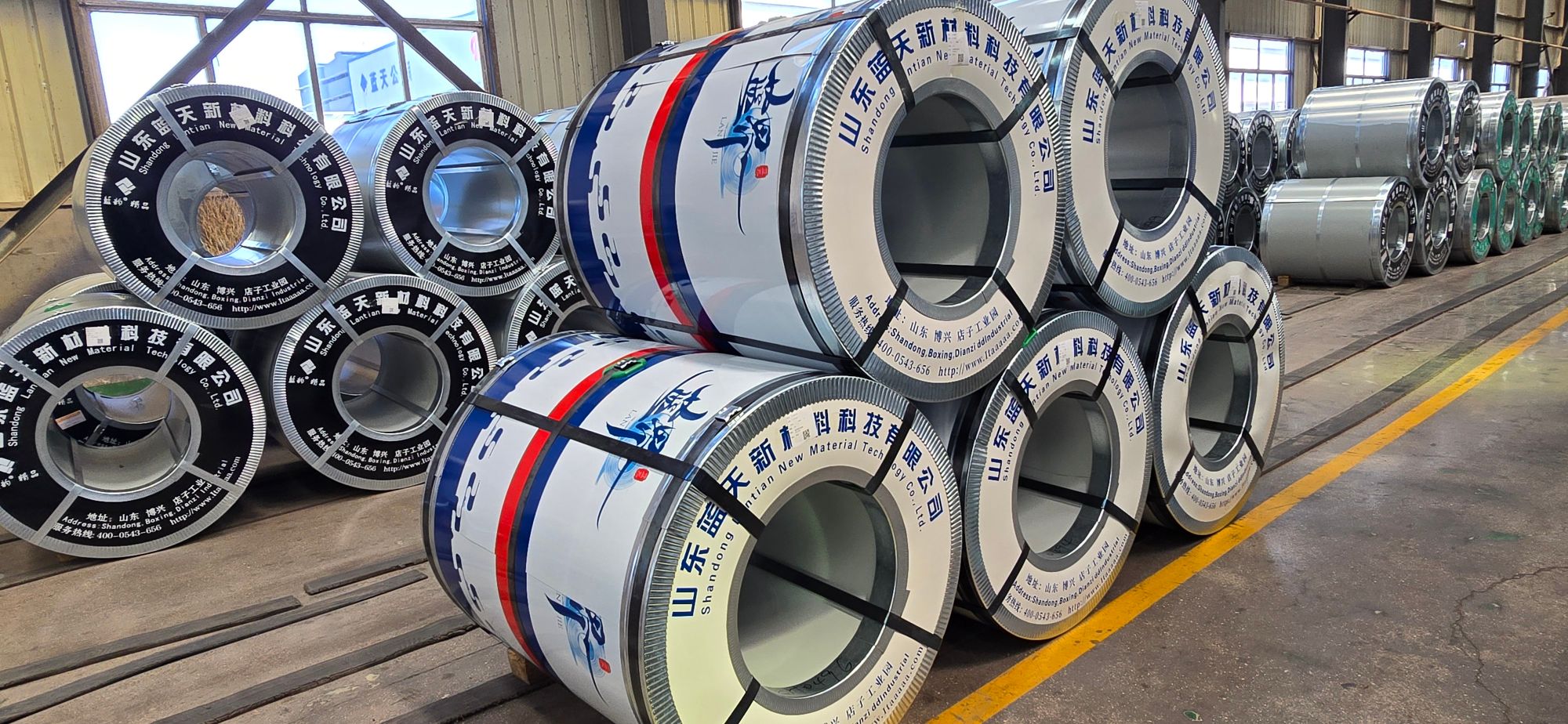
Many buyers fixate on coating thickness and color, but the base steel grade is what actually governs how a panel behaves under thermal stress. When the substrate lacks enough yield strength for the chosen profile and span, daily expansion and contraction slowly introduce permanent ripples. By the time visible warping shows up, replacement is usually the only reliable fix.
It is not just about gauge. Two coils can share the same thickness yet perform completely differently because one is a commercial-quality substrate and the other is a structural grade with tighter chemistry and mechanical properties. The softer choice may form easily at the rollformer but struggles to hold its shape once installed under direct sun.
The practical check is to ask for the actual ASTM grade or equivalent before ordering, not just the paint warranty. If the substrate grade is left off the quote, that ambiguity tends to appear later as wavy panels on a south-facing wall or roof.
Coating Thickness Tolerance and Why It Changes Color Uniformity
In optical thin-film deposition, coating thickness tolerance refers to the allowable deviation from the nominal layer thickness that still meets performance specifications. Even a few nanometers of variation can shift the interference conditions that determine which wavelengths are reflected or transmitted. When this tolerance is exceeded, the spectral response of the coating drifts, and the perceived color shifts with it. The eye is remarkably sensitive to small wavelength shifts in the visible range, especially in greens and cyans, so a tolerance that seems negligible on paper can produce visible color non-uniformity across a single coated surface or between batches.
Color uniformity breaks down because thickness errors do not distribute evenly across the entire optic. Deposition sources have spatial profiles: the center of a substrate often receives more material than the edges, or vice versa, depending on chamber geometry and source-to-substrate distance. This creates a gradual thickness gradient. Under broadband illumination, different regions of the coating then reflect slightly different peak wavelengths, appearing as a subtle rainbow or blotchy tint. The problem becomes more pronounced in high-reflection or narrowband filter designs, where the reflectance band is steeply sloped—a two-nanometer thickness error can shift the edge by several nanometers, enough to change the hue from blue-green to yellow-green.
Tightening coating thickness tolerance is therefore not just about meeting a nominal optical density or reflectance value; it is about preserving chromatic consistency. Process engineers typically monitor thickness with quartz crystal microbalances or optical monitors during deposition, then adjust tooling factors and mask designs to flatten the thickness distribution. For parts used in architectural glass, display covers, or camera lenses, the acceptable tolerance is often driven by just-noticeable color difference thresholds (ΔE*ab below 1.0 or even 0.5 in critical applications). Without such control, even coatings that pass a single-point spectrophotometer test can fail a visual inspection, revealing why thickness tolerance is the hidden variable behind color uniformity.
Pretreatment Steps That Keep Paint from Peeling in Humid Climates
Before you even open a can of paint, the surface has to be bone dry and free of anything that traps moisture. In humid climates, a quick wipe-down is not enough. Wash walls and trim with a TSP substitute or mild detergent, then go over any dark or greenish patches with a bleach-and-water mix to kill mildew spores. Rinse thoroughly and give the area at least a full day to dry—longer if the air is heavy.
Next, sand back any glossy or flaking areas to create a strong bond. Remove loose paint completely and feather the edges so the new coat does not sit on a weak layer. After sanding, vacuum and wipe the surface with a tack cloth to get rid of dust that can hold air and moisture beneath the finish.
Finally, seal everything with a moisture-resistant primer before applying the topcoat. Use an oil-based or shellac primer on bare wood or masonry, and a bonding primer on glossy or previously painted surfaces. Pay extra attention to joints, corners, and the bottom edges of windows and doors, where warm, damp air tends to condense. Let the primer dry completely, and if you are painting wood, check the substrate with a moisture meter—ideally it should read below 14 percent before you proceed.
Accelerated Weathering Tests and What They Actually Predict for Your Roof
Accelerated weathering tests subject roofing samples to concentrated UV light, heat, and moisture in a controlled chamber. These machines compress years of sun, rain, and thermal cycling into weeks or months. The main value is comparative: you can rank different membranes or coatings under identical stress and spot early failures like chalking, cracking, or adhesion loss. What they don’t do is give you a precise service life in years. Real roofs face variable angle, pollution, hail, and installation defects that no lab can fully replicate.
A common mistake is treating the test hours as a direct predictor of field longevity. A 5,000-hour QUV run does not equal 20 years on a rooftop. Instead, the data tells you which formulations are likely to degrade faster than others when exposed to the same spectrum. For example, a coating that retains 80% of its gloss after 2,000 hours is probably more UV-stable than one that chalks at 500 hours. The actual years you get depend on climate, slope, and maintenance—none of which are in the chamber.
Batch Consistency Checks That Prevent Visible Stripe Differences on Facades
Batch-to-batch shifts in pigment load, firing temperature, or coating thickness rarely show up on a single panel. Stack a few dozen panels on a wall, though, and those tiny differences start to align into faint horizontal or vertical bands. Catching them at the factory means comparing production samples under fixed daylight and cool-white lamps, not just relying on a quick visual sweep of the top sheet.
A practical check interval is tied to raw material lots, not calendar days. When a new lot of aggregate, cement, or coating enters the line, pull three or five panels from early, middle, and late in that run. Measure their colour with a spectrophotometer and place them side by side with the previous approved batch on a neutral grey backing. Pay attention to gloss and surface texture as well, since a shift in sheen can read as a stripe even when the measured colour stays within tolerance.
The final step is recording what you see and feel, not just the numbers. Keep a small physical archive of each approved batch, labelled with the production date and supplier lot. If a later delivery drifts toward the edge of the agreed Delta E range, quarantine it before it leaves the yard. That kind of early gatekeeping is far cheaper than re-cladding one elevation after the sun hits it from a different angle.
FAQ
A reliable way is to request a bend test report. If the coating cracks or flakes off during a tight 180-degree bend, that's a red flag. Quality mills usually aim for no more than minor hairline cracks at zero T-bend, and they can provide video evidence from their own lab.
The zinc coating is the real corrosion fighter. For most exterior building profiles, a minimum of Z120 (120 g/m² total both sides) is a practical baseline. In coastal or humid areas, you should push for Z180 or Z275. Without enough zinc, the paint film can look perfect but the cut edges will rust surprisingly fast.
Fading usually comes down to the pigment type, not just the topcoat thickness. Cheap organic pigments break down under UV within two years, while high-end ceramic or inorganic pigments can hold color for over a decade. Ask the manufacturer for a UV accelerated aging test result (QUV 1000 hours or longer) and compare the Delta E values.
Not necessarily. A 20-micron topcoat with good resin chemistry can outperform a 30-micron coat made from low-grade polyester. The key is the resin system: SMP and PVDF provide much better weather resistance than standard PE. But for simple indoor use, standard PE around 15-18 microns is often enough and saves cost.
Watch for pinholes, solvent popping, roller marks, and uneven gloss patches. Small particles or slight waviness can happen, but if you see recurring pinhole clusters or a gritty feel across the sheet, that suggests poor oven curing or contaminated rollers. A high-quality line will have continuous surface inspection cameras and reject anything beyond agreed tolerances.
Ask about their in-house testing routine. A serious mill will test every coil for film thickness, gloss, color difference, and T-bend adhesion, plus run random salt spray tests. If they hesitate to share batch-level test data or only provide a generic certificate, treat that as a warning sign.
For marine environments, PVDF (fluorocarbon) is the safest choice because it resists salt spray and UV damage far better than polyester. If budget is tight, an SMP coating with at least 25 microns topcoat plus a thick zinc base (Z275) can be a workable alternative, but expect more frequent cleaning and earlier repainting.
Conclusion
In the race to source pre-painted steel that survives real-world conditions, the differences between a dependable PPGI supplier and a short-lived bargain often hide in details that don't show up on a spec sheet. Coating adhesion tests—cross-hatch, bend, and reverse impact—quickly separate panels that will keep their film intact under thermal movement from those destined to crack and flake within a few seasons. Just as critical is the base steel grade: a thinner or lower-yield substrate may pass visual inspection, but it warps under roof loads or thermal stress long before the coating fails. Coating thickness tolerance also deserves more attention than it gets. A few microns of drift can shift perceived color uniformity across a roof, especially with lighter shades, because pigment distribution and surface texture change with film build. And in humid or coastal climates, pretreatment steps like alkaline degreasing, rinsing consistency, and conversion coating quality are what keep paint from peeling at the edges and fasteners.
Accelerated weathering tests—QUV, salt spray, and cyclic corrosion—don't hand you a service-life number, but they do reveal how a coating system handles UV, moisture, and thermal cycling compared to a known benchmark. A supplier that can explain what those tests actually predict, and which they don't, is more valuable than one quoting a 20-year warranty with no data behind it. Batch consistency is the last frontier for architects and fabricators who care about facades: minor variations in primer color, gloss, or film thickness between production runs can show up as visible stripes across a building. Smart buyers ask to see retained samples from consecutive batches and records of color measurement, not just a single certificate. When these checks align, the PPGI you choose is far more likely to hold its color, stay flat, and resist peeling years after installation.
Contact Us
Contact Person: Nia
Email: [email protected]
Tel/WhatsApp: +86 18954360337
Website: https://www.sdppgi.com