

PP Hollow Grid Board Production Line Factory: A Complete Overview of Manufacturing Equipment and Processes
2026-10-26
Take a walk through any modern packaging workshop or construction site and you'll likely spot PP hollow grid boards—lightweight yet tough, moisture-proof, and endlessly reusable. But behind every crisp sheet lies a sophisticated production line where extrusion, die forming, cooling, and cutting must work in perfect sync. At COMRISE, we've built our reputation on engineering those precise, high-output systems. What follows is a behind-the-scenes look at how our factory turns raw polypropylene into finished grid boards—and why equipment choices matter far more than most buyers expect.
From Pellets to Melt: Inside the Extruder and Filtration Setup
In most extrusion lines, the real transformation starts quietly: pellets enter the feed throat, get pulled forward by the screw, and begin to shear against the barrel wall. The temperature profile is rarely uniform — some zones run hotter to soften the material, while others stay cooler to keep friction in check. By the time the melt reaches the end of the screw, it has been worked, mixed, and compressed into a homogeneous stream that no longer resembles the original granules.
What that stream still carries, though, are tiny contaminants, degraded specks, or unmelted fragments. This is where filtration earns its place. A screen changer or continuous filter positions a woven mesh directly in the melt path, trapping particles that would otherwise tear through the die or show up as defects in the final product. Pressure sensors on both sides of the screen tell the operator when the mesh is loading up, so a changeover can be timed without disrupting the line more than necessary.
Shaping the Grid: Die Geometry and Vacuum Calibration Explained
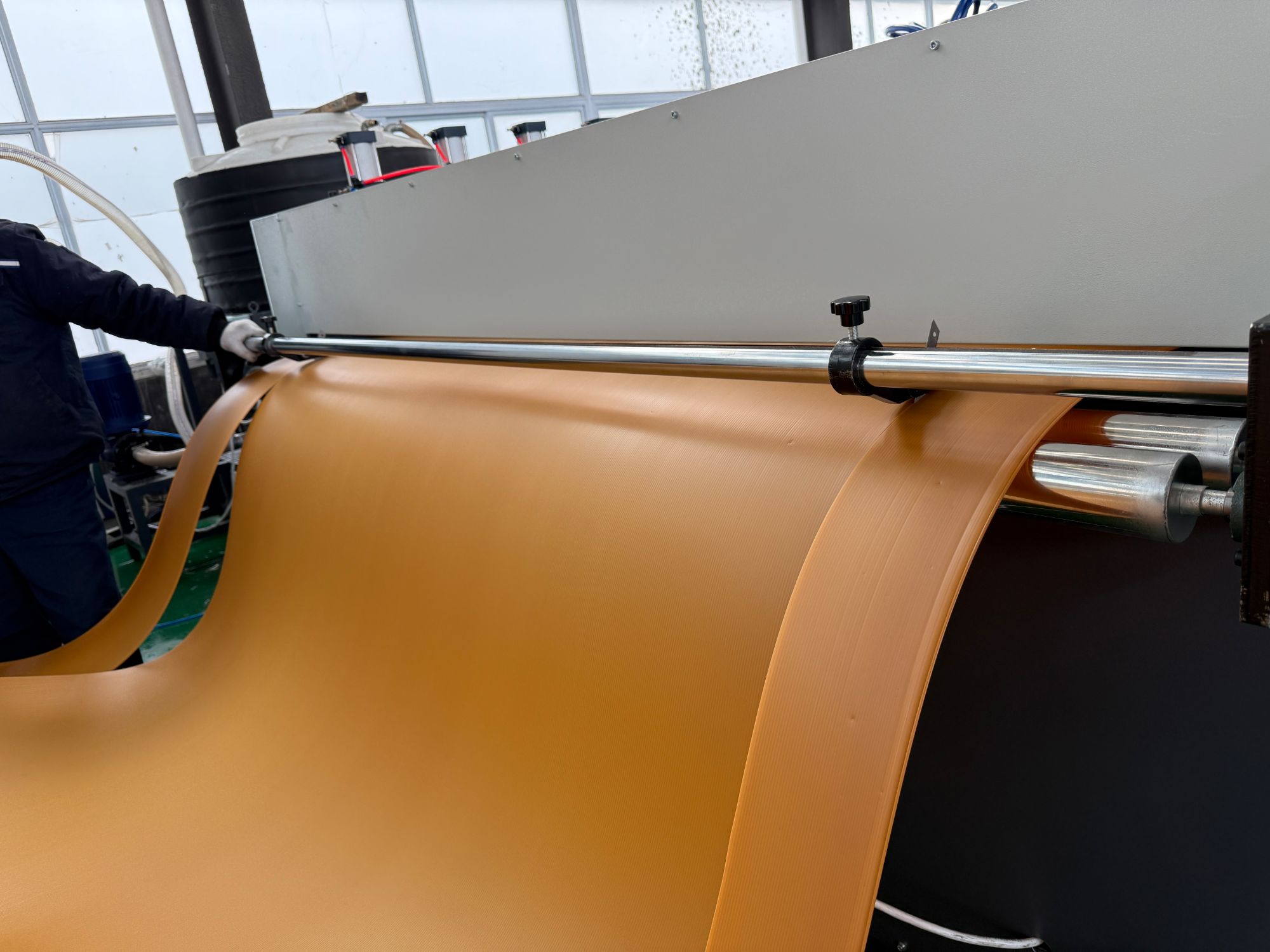
Every extrusion line hinges on one quiet truth: the die does not simply shape plastic, it negotiates with it. Die geometry sets the initial cross-section, but the melt remembers its own elastic past. A sharp corner in the die lip can become a stress riser downstream, so lip radii and land lengths are tuned not for the drawing on the engineer's screen, but for the way the polymer relaxes once it clears the land. Small changes in the approach angle or the pre-land taper shift the velocity profile, and that shift shows up later as warpage, edge tear, or a surface that never quite glosses the way the spec demands.
Vacuum calibration then takes over where the die's promises end. The profile exits the die at melt temperature, still soft, still swelling slightly from die swell. The calibrator tank applies a controlled negative pressure around a series of forming plates that cool and hold the shape. Here, geometry becomes a conversation: the first plate does the heavy pulling, the middle plates lock the corners, and the final plates act as a gentle hand-off to the cooling water. If the vacuum slots are too wide or too narrow, the profile either chokes or floats, and the result is a dimensional drift that no amount of downstream tweaking can fix.
The trick is learning to read the grid. Experienced operators watch the water line creep, listen to the pump's pitch, and feel the tension in the haul-off. They know that a vacuum level that works for a 3 mm wall will starve a 6 mm wall, and that the calibrator's inlet geometry must match the die's exit angle within a few degrees. Once that match is found, the line settles into a rhythm: the die defines the potential, and the vacuum calibration decides what actually survives the bath.
Cooling Without Distortion: Water Bath and Air Knife Tuning
Getting a clean, even quench without warping thin or intricate profiles often comes down to how the cooling media meets the part. A water bath can pull heat fast, but if the agitation pattern is wrong or the part enters at an odd angle, you'll see one side shrink more than the other. The fix usually isn't more water—it's better entry geometry and a deliberate pause before full immersion so the initial chill doesn't create thermal shock.
Air knives solve a different problem: removing residual water from recesses or blind holes before the next process step. Instead of blasting with high pressure, tune the knife gap and angle so the air flows laminar across the surface. Too much turbulence just pushes water around rather than peeling it away. A simple test is to place a strip of thin plastic in the airstream and watch whether it flutters violently or lies flat—flat means you're close.
The real trick is combining both stages. After the water bath, a short dwell lets the part temperature equalize slightly, then the air knife removes surface moisture without re-cooling the core. Adjust the distance from bath to air knife and the dwell time until the part comes out uniformly dull, with no streaking or localized wet spots. That's the visual signature of balanced cooling.
Pulling and Cutting: Synchronizing Line Speed for Clean Edges
When you pull wire, filament, or any continuous stock through a cutter, the edge quality lives or dies by how well the pull speed matches the slice moment. If the material is still drifting forward as the blade comes down, you get a dragged edge—tiny tears, stretched burrs, or a bevel that wasn't in the spec. It looks like the cut was rushed, even if the tool itself is sharp.
The fix isn't a faster blade or a tighter clamp. It's treating the pull and the cut as one continuous motion. By using an encoder on the drive roller and tying the cutter trigger to the exact line position, you can make the blade fire when the stock is momentarily stationary relative to the cutting edge. Some setups notch the speed just before the cut, letting inertia settle, then resume full pull. The result is a crisp, square face without secondary deburring.
This matters most with soft or brittle materials—think PTFE tubing, thin-gauge wire, or extruded profiles that tear before they shear. Once the synchronization is dialed in, scrap rates drop and operators stop babysitting the line. Clean edges become a rhythm, not an accident.
Automated Stacking and Packing: End-of-Line Handling Systems
Modern warehouses rarely leave stacking and packing to chance. Automated end-of-line systems bring a level of repeatability that manual labor simply can't sustain across three shifts. Robotic palletizers, layer-forming stations, and stretch wrappers work in sequence, guided by sensors and software that adjust patterns on the fly for mixed SKU batches.
The real advantage shows up when product dimensions vary. Instead of reprogramming an entire line, operators switch stacking patterns through an HMI or let the system choose based on barcode data. This flexibility cuts changeover time and protects fragile goods by adjusting grip pressure and layer height.
Maintenance and uptime deserve mention too. Built-in diagnostics flag misaligned boxes or low film levels before they cause downtime. That kind of visibility means a packaging line can run longer with fewer interruptions, and the consistency of each pallet keeps downstream warehousing and transport smoother.
Keeping Cells Consistent: Inline Quality Checks and Adjustments
Maintaining consistency across spreadsheet cells rarely happens by accident. A few mistyped date formats or a stray trailing space can quietly break sorting, pivot tables, and lookups. The first line of defense is to restrict what can be entered in the first place. Set data validation rules on key columns: force a dropdown for status labels, limit numeric fields to a sensible range, and require dates to fall within a specific window. This keeps the most common errors from ever reaching the sheet.
Validation alone won't catch everything, especially when data arrives from imports or collaborative edits. Inline formula checks are more flexible. Add a dedicated audit column that compares related cells and returns a short error code instead of a generic warning. For example, =IF(COUNTA(A2:D2)=0,"EMPTY",IF(SUM(E2:G2)<>H2,"SUM_MISMATCH","OK")) flags rows where required fields are blank or totals don't line up. Combine this with conditional formatting so any cell containing an error code turns a soft red, making problem rows impossible to miss during review.
Corrections should not erase the original value, because losing context makes it harder to spot recurring issues. When an inconsistency is found, insert an adjacent "adjusted" column and leave the raw entry intact. Record the reason in a short notes field, and if the sheet supports it, add a timestamp or editor identifier. This creates a lightweight audit trail that helps you see whether errors are one-off mistakes or signs that the input form or import process needs a stricter rule upstream.
FAQ
Virgin polypropylene pellets form the base, often blended with calcium carbonate filler to lower cost and increase stiffness. Many lines also run recycled PP flake or regrind at controlled percentages. Color masterbatch, UV stabilizers, and antistatic agents are metered in through side feeders or gravimetric dosing units so the final sheet meets specific end-use requirements without degrading the melt.
A single-screw extruder with a length-to-diameter ratio of at least 30:1 gives better melting and mixing. Barrel temperature zones are usually set from about 180°C near the feed throat up to 230°C at the metering section. A melt pump between the extruder and die is critical because it steadies output pressure and eliminates surging, which otherwise shows up as thickness variation or weak spots in the grid walls.
The die head splits the melt into a series of parallel channels and ribs that become the board's hollow cells. Internal flow channels have to be balanced so each cavity fills evenly, otherwise one edge will be denser than the other. Adjustable choker bars or restrictor bolts allow operators to fine-tune local flow, and die lip gaps can be changed slightly to correct thickness profile across the width.
After leaving the die, the sheet enters a vacuum calibration unit. Here it is pulled through a series of water-cooled sizing plates or calibrators that use vacuum to press the soft PP against the tool surfaces. Water temperature is usually kept between 15°C and 35°C, and the cooling is staged so the outside skin hardens first while the core remains warm enough to relax internal stress. This prevents bowing and warping in the final boards.
A traveling cut-off saw or shear cuts the continuous board to preset lengths, typically synchronized with the puller speed so the cut edge stays square. After cutting, boards land on a roller conveyor with an automatic stacker that counts sheets and forms neat piles. Some factories add a robot or vacuum lift for palletizing, especially when producing large-format boards that are awkward to handle manually.
Most lines cover 2 mm to 12 mm thickness, though some heavy-duty machines go up to 20 mm or more. The limiting factors are the die lip opening, the depth of the vacuum calibration tooling, and the cooling length. Thinner boards need higher line speeds and tighter temperature control, while thicker boards require slower cooling and more careful vacuum adjustment to keep the cells from collapsing.
Operators usually monitor thickness with a non-contact laser or beta gauge across the sheet width, and a camera system flags holes, dark specks, or cell collapse. Sample boards are weighed to check grammage, measured for flatness on a granite table, and sometimes tested for compression strength or impact resistance. Data from these checks is recorded per batch so problems can be traced back to raw material lots or machine settings.
Yes. A co-extruder can add a thin solid skin or a different color layer on one or both faces. Embossing rollers imprint textures such as a matte or diamond pattern while the surface is still hot, and online corona treatment can boost adhesion for later printing or laminating. Additives like flame retardants, anti-UV packages, or conductive fillers are simply changed through the dosing system, so the same line can switch between packaging boards, advertising panels, and construction protection sheets.
Conclusion
In a PP hollow grid board production line, the journey starts with polypropylene pellets being fed into a single-screw extruder, where controlled heating and shear convert them into a homogeneous melt. A screen changer removes contaminants before the melt reaches the die. The die geometry—often a flat sheet die with internal mandrels—gives the board its characteristic hollow grid structure. Immediately after extrusion, vacuum calibration pulls the hot profile against chilled sizing plates, locking in precise cell dimensions. The board then passes through a water bath and a set of air knives; the water bath cools the core evenly, while the air knives strip excess surface moisture and prevent warping or dimpling.
Further downstream, a caterpillar puller maintains constant line speed, and a servo-driven cutter synchronizes with the puller to produce clean, square edges without crushing the cells. Automated stacking systems collect the cut boards into counted bundles, and stretch-wrapping or strapping stations prepare them for shipment. Throughout the run, inline sensors measure wall thickness, cell uniformity, and surface defects, feeding data back to the extruder and calibrator. Operators make fine adjustments to melt temperature, vacuum pressure, and pulling speed, ensuring every board meets the required flatness and crush resistance. This integrated approach keeps the line efficient and reduces manual handling.
Contact Us
Contact Person: LISA LEE
Email: [email protected]
Tel/WhatsApp: +86 13780696467
Website: https://www.qdpipemachine.com