

Decorative Flowers Original Manufacturer Reveals the Art of Lifelike Arrangements
2026-09-22
There’s a moment when you lean in to touch a decorative flower, certain it’s real—only to find silk, foam, or latex. That’s the quiet victory of a truly lifelike arrangement. PHLEEYA, as an original manufacturer, doesn’t just sell faux blooms; it engineers that moment. Here’s a look at the artistry and obsession behind every stem.
Petal by Petal, the Slow Craft of Believable Blooms
A single petal cut from fine silk holds no promise until it passes through your fingers. You warm the edges with a small iron, press a vein into the underside, and watch the fabric curl just slightly—the way a real petal does after a morning of sun. No two come out the same, and that is the point. Machine-made flowers repeat themselves into lifelessness. The slow craft lives in the wobble, the uneven ruffle, the barely-there difference that your hand leaves behind.
Color arrives in thin washes, not broad coats. You dip the tip of a brush into diluted dye and touch it to the petal's base, letting the pigment bleed outward like water moving through a stem. Over days, you build layers: a blush at the throat, a faint green where the petal would have met the calyx, a loss of saturation near the rim. This is not imitation by formula. It is remembering how light falls on a garden after rain, then teaching the fabric to hold that memory.
When the bloom finally sits on its wired stem, it has already spent hours being shaped, dried, and coaxed. The slow craft asks for patience because believability is not a trick. It is the result of paying attention to the small refusals—the petal that will not lie flat, the dye that dries too bright, the stem that bends left instead of right. In the end, people lean close not because they cannot tell it is handmade, but because they almost can.
Why We Study Real Flowers Before Making Fake Ones
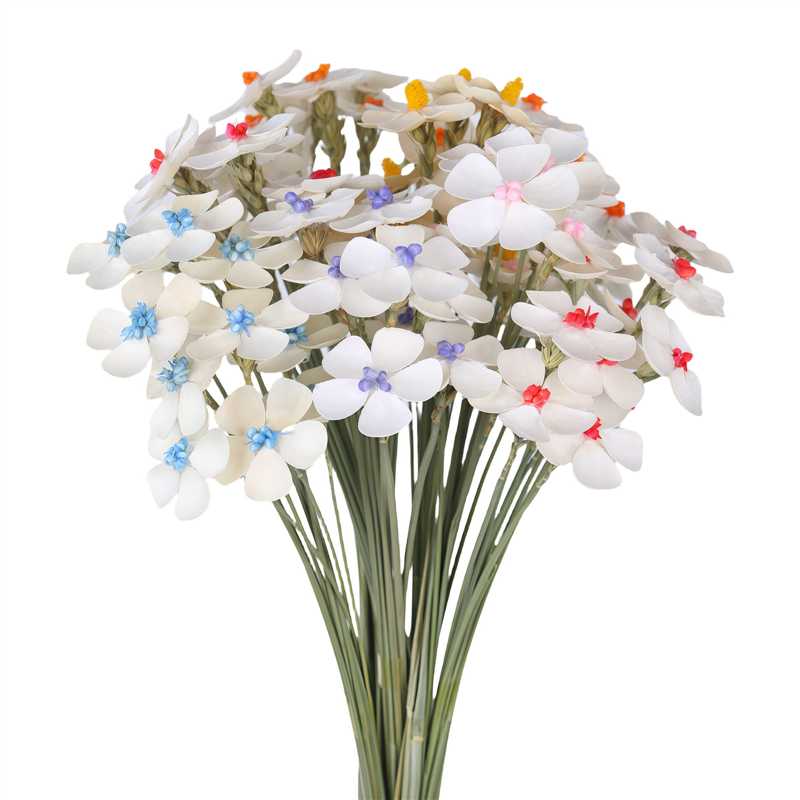
The reason we begin with living blooms isn't about copying petals exactly. Real flowers have weight, gesture, asymmetry, and the way light travels through veins. A silk rose can look stiff if its maker never watched a real rose bend in the wind. Observing how stems curve, how buds unfurl, and how leaves attach at nodes gives artificial versions a sense of life.
There is also texture and color that photographs flatten. Touch a real petal and feel its slight grain, the coolness of sap, the paper-thin edge fading to translucency. These small truths inform dye choices, fabric selection, even the way we crimp edges. Without them, fake flowers become caricatures rather than companions to living ones.
Ultimately, studying real flowers teaches restraint. Nature rarely repeats itself; no two petals are identical. We learn to introduce irregularity on purpose—a tilted bloom, a torn leaf, a fading color—so the artificial piece can hold the same quiet presence as the real thing. That is why the field notebook and garden walks come first.
The Art of Imperfection, Making Faux Feel Alive
The quickest way to make a faux leaf, stem, or hide look artificial is to make it flawless. Real leaves carry tiny scars, uneven veining, and color that shifts from base to tip. A believable faux piece needs those same interruptions—a leaf with a faint brown edge, a stem that bends a little too sharply, a petal whose edge isn't a perfect arc. These aren't defects; they're the fingerprints of growth and weather.
Working with faux greenery or leather becomes more convincing when you treat each piece as an individual rather than a repeat from a mold. Turn some leaves backward, let a stem droop at its own angle, and add a wash of diluted acrylic to break up suspiciously even color. For faux leather or suede, press creases into high-wear spots—near a handle, along a fold—instead of distributing wrinkles evenly across the whole surface. The eye notices when variation is too regular.
The underlying idea is simple: we accept something as alive when it offers small surprises. If every leaf, stitch, or wrinkle matches the next, the brain flags it as manufactured. Imperfection lends a sense of time and touch, whether it's a faded patch that suggests sunlight or a slightly misshapen stem that implies it grew around an obstacle. Study the real thing not to copy a single perfect example, but to capture the natural range of difference.
Hand-Finished Details You Can Spot Up Close
Run your thumb along the seam where the leather meets the lining. There’s a slight give there, a softness that only comes from pressing, folding, and smoothing each edge by hand rather than feeding it through a machine. The stitches aren’t perfectly uniform—look closely and you’ll catch a needle’s pause, a tiny variation in tension that tells you someone was watching the thread go in and out, adjusting as they went. It’s the kind of detail that disappears in photos but feels immediate when the object is in your hand.
At the corners, the material turns inward with a rounded, almost pillowed curve. No sharp crease, no glue squeeze-out. The edges have been burnished with repeated strokes until they take on a faint sheen, like the rim of a well-used wooden spoon. Even the underside, the part that rarely gets seen, carries small tells: a slight irregularity in the trim, a hand-cut notch that isn’t laser-straight but sits flush against the frame. These marks aren’t flaws—they’re evidence of a slower process.
Hold it up to side light and you’ll notice the surface isn’t glassy or plastic-smooth. There’s a grain, a subtle topography left by hand-buffing that breaks the reflection into soft bands. Rub two sections together and the sound is low and muted, not the crisp click of a factory finish. It’s these small, repeatable discoveries—the warmth of an uneven stitch, the gentle radius of a trimmed edge—that make you want to look again, closer this time.
From Garden Photographs to Your Living Room
A sunlit peony, dew on a rose petal, shadows cast by tomato leaves—these aren't just fleeting moments in the garden. They become the starting points for something more permanent. When you print a photograph you took (or commissioned) and hang it above the sofa, the room starts to breathe differently. It's not about filling empty walls; it's about carrying a memory indoors, where it can settle into the rhythm of your daily life.
The trick is to let the image guide the room's mood without overdecorating. A close crop of fern fronds can feel calm and architectural in a bedroom, while a wide shot of wildflower chaos might bring just enough untidiness to a too-perfect dining nook. Framing matters, but so does restraint—one strong botanical print often does more than a gallery wall of six.
Eventually, the garden photograph stops being a record of a place and starts acting like a window. Morning coffee happens under a canopy of captured leaves; evening reading sits beside a frozen burst of color. The living room isn't separate from the outdoors anymore. It holds a piece of the garden that never fades, never needs watering, and never stops reminding you why you planted that seed in the first place.
Designing Custom Arrangements That Don't Look Designed
The trick to a custom arrangement that feels effortless is to stop treating every stem like it needs a job. Let some branches arc a little too far, keep a few buds slightly lower than the rest, and leave one side just a touch looser. That tiny bit of imbalance is what makes the whole thing read as gathered, not manufactured.
Work from the materials, not from a picture in your head. If the ranunculus are leaning left, let them lean. If a stem of jasmine wants to trail off the edge of the vase, give it room. The moment you force every element into a tight, symmetrical dome, you lose the quiet randomness that makes a design feel alive.
Color matters less than texture when you're after an unstudied look. Mix velvety petals with papery seed heads, glossy leaves with matte herbs. Pull a few things from your own yard or a neighbor's hedge—nothing too perfect. Those slightly irregular, everyday cuttings do more to soften a formal arrangement than any styling trick.
FAQ
Studying fresh blooms under different lighting is the starting point. Artisans then recreate the subtle color bleed, veining, and gentle curl by layering pigments and using textured molds, so the surface doesn't appear uniform or plastic.
Yes. Original manufacturers typically keep a color library and can tint petals, leaves, and even tiny stamen tips to coordinate with paint chips or fabric samples. This lets you get arrangements that feel like they belong in the space rather than standing out awkwardly.
A mix of matte finishing, fine surface texture, and strategic use of flocking on stems and leaf undersides removes the shine. Some producers also apply a final hand-brushed wash to selected areas, which introduces the slight imperfections found in nature.
They can be. Factories focused on realism often use UV-resistant polymers, fabric blends, and wired stems that keep their shape through frequent cleaning and handling. This makes them suitable for hotels, restaurants, and offices where fresh flowers would require constant replacement.
The curve of a stamen, the uneven spacing of leaves, and the way a heavy head droops slightly are all considered. Instead of repeating one template, original manufacturers work from live plant references and vary each stem so the finished arrangement feels collected rather than stamped out.
Many do. They may include layout suggestions, recommend vessel proportions, or offer virtual consultations to show how to bend stems and layer heights for a more organic look. This helps buyers avoid the rigid, upright placement that often makes artificial arrangements feel staged.
It usually takes between three and six weeks after a sample is approved. If the manufacturer already has the necessary molds and materials, rush timelines can sometimes be arranged, but detailed hand-finishing is worth the wait.
Conclusion
A decorative flowers original manufacturer approaches each stem as a study in patience. Instead of rushing through molds and dyes, artisans assemble believable blooms petal by petal, letting the slow craft reveal texture, weight, and the slight irregularities that make a flower feel alive. Before any silk or polyester is cut, the team spends hours with real flowers—noticing how petals curl at the edges, how stems bend under their own weight, and how no two blossoms open the same way. That close observation becomes the foundation for faux arrangements that breathe. Imperfection is deliberate: a faded spot, a lopsided bloom, or a leaf with a tiny tear keeps the piece from looking mass-produced.
Back in the studio, garden photographs are pinned to corkboards, guiding the transition from a living plant to a lasting arrangement. Hand-finished details—veining pressed into each leaf, subtle color shifts layered by brush, a stem wrapped with natural fiber—hold up even when examined up close. Custom orders are built around a client's light, shelf height, and surrounding decor, so the final piece doesn't scream "designed." Instead, it settles into a room as if it grew there. That is the real art of lifelike arrangements: not fooling the eye with perfection, but honoring the imperfect, patient gestures that make a flower worth remembering.
Contact Us
Contact Person: Mr. Luo
Email: [email protected]
Tel/WhatsApp: 86 18100895505
Website: https://www.feiliyaflowers.com/en/