

Bottle Unscrambler Exporters That Packaging Manufacturers Trust Worldwide
2026-11-21
Packaging manufacturers rarely have time to gamble on equipment that misbehaves once it reaches the factory floor. That is why the search for bottle unscrambler exporters usually comes down to one thing: a track record that holds up across borders. Wanying Machinery sits on that shortlist by turning steady engineering into dependable output. In this post, we break down what trusted exporters do differently—and what to look for before your next line expansion.
How Trusted Bottle Unscrambler Exporters Handle Mixed Container Runs
Mixed container runs create a different set of demands than single-shape production. Trusted exporters usually start by looking at the actual range of containers passing through the line, not just the diameters on a spec sheet. Height-to-diameter ratios, neck finishes, center of gravity, and surface tackiness all come into play. A machine tuned for one dominant profile can still struggle when a short, wide jar follows a tall, narrow bottle without enough adjustment time.
Rather than relying on a generic recipe, experienced suppliers often configure the unscrambler with quick-change guides, adjustable orienting tracks, and bowl speeds that respond to the lightest container in the batch. They may also run test cycles with the actual mixed set instead of a single representative sample. That makes it easier to spot transfer points where one container shape hesitates or drops, allowing the exporter to modify the pitch and air assist before the equipment ships.
The goal is not just to keep containers moving but to keep orientation accurate at discharge. A mixed run rarely behaves linearly, so trusted exporters focus on repeatability across the full envelope of shapes a customer plans to run. When done well, the line switches between formats with minimal mechanical intervention and the unscrambler maintains throughput without forcing operators to babysit the accumulation area.
Design Choices That Keep Unscramblers Running on Overnight Shifts
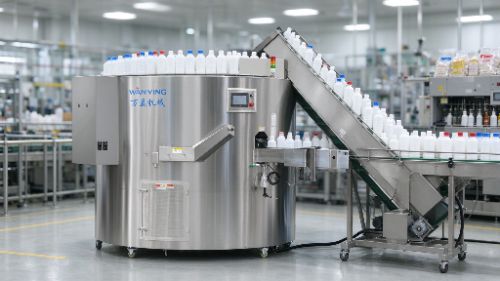
Unscramblers that hold up through the early morning hours tend to share a few quiet, practical traits. Tool-free access panels are the first thing many operators notice. When a bottle jams at 2 a.m., nobody wants to hunt for a hex key or wait on a maintenance ticket. Machines with quick-release guarding, simple rail adjustments, and clearly marked pinch points let a small night crew clear stoppages in minutes instead of losing half the shift.
Sensing and indicator placement matter just as much as mechanical access. On a dimly lit line, a single status light can tell the difference between a minor misfeed and a dead motor. Unscramblers designed for night operation often keep sensors low and easy to wipe, with simple color codes that don't require reading a screen. Vibration-resistant mounts and fewer exposed wires also cut down on the kind of intermittent faults that only seem to appear when the daylight engineers are gone.
Then there is the matter of adjustment. Changeovers that rely on fine-thread dials or hard-to-read scales tend to get rushed after midnight. Better designs use detents, preset marks, or hand knobs that click into place, so an operator can switch bottle sizes without second-guessing. The goal is not fancy automation; it is giving the overnight crew a machine that behaves predictably when the rest of the plant is asleep.
What Plant Engineers Ask Beyond the Brochure
Once the glossy spec sheets are set aside, the conversation shifts to clearance around the pump casing, whether the local tech actually stocks the seals, and how long a rebuild really takes when the line is down. Engineers want to know if the performance curve holds at 85 percent load, not just at the ideal point printed on page four.
They also ask about the failure history nobody puts in the datasheet: which bearing tends to go first, what vibration signature shows up before trouble, and whether the control interface plays well with the plant's existing historian. If the vendor's answer starts with a long pause, that tells them more than any reliability claim.
Beyond price and lead time, the real questions center on everyday friction—how the equipment behaves after a power dip, whether the spare parts list is honest about consumables, and if the OEM will still pick up the phone three years after commissioning. Those details rarely make the brochure, but they decide how the machine earns its place on the floor.
When a Bottle Unscrambler Arrives Ready for the Line
A bottle unscrambler that shows up already aligned, wired, and tested changes the first hour on the floor. Instead of sorting through loose brackets or re-tightening parts that shifted in transit, the crew can roll it into position, lock the casters, and connect air and power. The pre-run checks feel more like a confirmation than a rebuild, which keeps the startup window short and the line moving toward actual production.
That readiness also shows up in small details: labeled connection points, guarded sensors already aimed, and changeover settings saved from the factory floor. When the machine arrives in this state, the usual back-and-forth between mechanical and electrical teams fades. Operators can spend their time learning the rhythm of the unscrambler rather than chasing loose ends.
Support Across Borders Without Waiting on Office Hours
When your workday ends, someone else's is just beginning — and that's exactly why your support shouldn't have a clock. Our team spans multiple time zones, which means urgent requests get picked up while you sleep, not queued for tomorrow morning. No voicemail limbo, no automatic replies promising a callback within two business days. Just a real person, somewhere in the world, already looking at your ticket.
That global coverage shifts how problems get solved. A billing issue filed from Singapore at midnight doesn't sit untouched until a U.S. office opens; it moves forward within the hour because a colleague in Amsterdam is online and fully trained on your account. The handoff feels seamless because it isn't a handoff at all — every teammate uses the same internal notes, the same standards, the same straightforward language. You never need to explain the same issue twice.
We also avoid the trap of treating after-hours support like a second-class channel. The same senior people who answer during peak hours rotate through nights and weekends, so you're not stuck with a script-reading novice when a database migration goes sideways. Access is simple: one login, one place to see every conversation, regardless of which continent answered it.
Upgrading an Aging Unscrambler Without Halting Production
The unscrambler had been running long enough that its original relay logic was held together with handwritten notes and a few jumpers nobody wanted to touch. Instead of a full rip-and-replace, we mapped the failure points over two weeks of shift logs and found most downtime clustered around the bowl drive and the discharge sensor. Those were swapped first during a planned sanitation window, with temporary photoeyes mounted on a nearby rail so the line could restart while the old brackets were cut away.
Controls came next. The new PLC was installed in a spare enclosure and wired to terminal blocks in parallel with the existing relays, which let us test each output against the live machine without ever dropping the main run signal. Over the course of a weekend, we moved one function at a time — bowl speed, air jets, lane diverters — until the old relay board was just a dead panel. By Monday it had been removed, and the line was already running on the new logic at reduced speed for the first shift.
The final upgrade was the sort that usually forces a shutdown: replacing the rotary pocket wheel and wear plates. We staged the new parts beside the line, pre-assembled the wheel on a spare shaft, and swapped it during a product changeover when the unscrambler was already empty. The old parts went out the same way the new ones came in, and production never missed a scheduled run.
FAQ
They usually dig into installed references, spare part availability in their region, and how the exporter handles their specific bottle shape. A trustworthy exporter talks about changeover times and air consumption instead of only quoting maximum speed.
It often comes down to engineering depth and reliability on demanding lines. Overseas exporters with a long track record tend to handle unusual bottle geometries, heavier production schedules, and faster changeovers better than smaller local options.
Ask about reject rates, static buildup, label handling, and how the machine deals with lightweight PET. An experienced exporter will mention feed system differences, brush adjustments, and practical output under real line conditions rather than ideal numbers.
The real difference shows in small things: quick-release guides, recipe storage for different bottle families, gentle bottle handling to avoid scuffs, and clear documentation. Trusted exporters also stay involved after installation when the line changes.
Yes, the stronger ones do. They may revise pocket profiles, add vision checks, or adjust discharge height to match existing conveyors. The best results come when the exporter asks for bottle samples and current floor plans before quoting.
A dependable exporter should offer remote troubleshooting, clear spare part diagrams, and honest lead times. The best support usually comes from a service engineer who knows the specific machine rather than a general call center, especially when a line is down.
It can be, but the risk drops sharply when the exporter has local service partners, proper compliance certifications, and clear freight handling. Asking about recent installations in your country and how they handled shipping damage reveals more than brochures do.
They ask for floor plans, conveyor heights, and upstream or downstream speeds before the order is finalized. Many also share mechanical and electrical drawings early so the machine fits the existing line without forcing the buyer to solve integration problems later.
Conclusion
Packaging manufacturers return to the same bottle unscrambler exporters for a reason. Those suppliers have learned how mixed container runs actually behave on a live line. Instead of quoting a single ideal bottle shape, they ask about neck rings, base stability, label friction and even static buildup from freshly blow-molded PET. That matters because a machine tuned for one jar can stall when a short lot of oval bottles follows a tall cylinder run. Trusted exporters often fit quick-change guides, adjustable bowl tooling and recipe-driven hopper settings so operators can switch formats without reaching for wrenches. Their design teams also look past daytime demos, selecting drives and sensors that do not drift after ten hours of heat, dust and conveyor vibration. When plant engineers push beyond the brochure, the answers cover things like spare part lead times, wear strip tolerances and whether the unscrambler can recover from a fallen bottle jam without a full line stop.
The same practical mindset shows up before installation and long after startup. A machine that arrives ready for the line usually means the exporter pre-wired interfaces, verified air consumption and matched the discharge height to existing conveyors, so the crew spends less time improvising on the floor. For plants running overnight, support across borders has to work without waiting on office hours; that often means remote diagnostics with logged fault histories, local service partners and critical spares positioned near the customer. When an aging unscrambler needs replacement, the stronger exporters stage the upgrade in phases, running new equipment beside the old line until the transfer is proven, then cutting over during a planned gap. This keeps output steady while the plant gains gentler handling, faster format recall and quieter operation. Trust is built on those details, not on glossy claims.
Contact Us
Contact Person: Tyson
Email: [email protected]
Tel/WhatsApp: +8613396971296
Website: https://www.wanyingmachinery.com